Building Digital Portfolios
Create memorable learning archives

Your students are creating fantastic projects to show what they know. You can take their learning, and your ability to assess their achievement, to an even higher level using digital portfolios. Portfolios have long been a mainstay in the visual arts, where skill and expertise cannot be accurately represented by percentage points and letter grades. Electronic portfolios have been around for years, but the advent of powerful new technologies makes building, maintaining, sharing, and archiving student learning in digital form easier than ever before.
A digital portfolio is a computer-based collection of student performance over time. Portfolios make classroom learning more accessible to parents, administrators, and other district support staff because they provide a window into student learning. A portfolio showcases both student achievement and student learning over time. To demonstrate growth, a portfolio will often include similar work done over the course of several years.
What Should a Digital Portfolio Include?
When used as a student assessment tool, digial portfolios should demonstrate that “the student is involved in meaningful performance tasks; there are clear standards and criteria for excellence; there is an emphasis on metacognition and self-evaluation; the student produces quality products and performances; there is a positive interaction between assessor and assessee.” (Burke, 1999) The performances students include in their portfolios should be related to the curriculum and evidence their engagement in meaningful learning.
Students should choose the content of their portfolios with the clear understanding that the items must include examples of their best performances, demonstrations of achieving a particular objective, and examples showing personal and academic growth. The content should be indicative of a wide range of skills and abilities and provide clear demonstration of student ability.
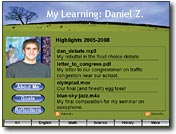
One of the most important ingredients in a portfolio is the student’s reflection on their work. Students should include reflections on each performance to clarify why pieces are included in the portfolio. This is perhaps the most valuable part of the portfolio, since it provides a much clearer window into the learning of each student. Student reflections help us “discover and observe what our children are really experiencing, thinking about, questioning, wondering about, trying, and attaining.” (Niguidula, 2002) In the words of John Dewey, “We don’t learn from experience; we learn from reflecting on experience.” The tools used for creating digital portfolios make it easy to type or record a voice reflection.
A portfolio should also include clear criteria for judging the merit of each performance contained in it. Portfolios should include a detailed rubric explaining the effectiveness and overall value of each performance. The rubric helps students understand expectations and provides a guide as they reflect on the different aspects of their performance.
What Is the Teacher’s Role?
Because portfolios include a collection of performances that demonstrate growth and include student reflections, they provide additional assessment information beyond what can be gleaned from a traditional letter grade. In the same way that a simple letter grade may not capture learning that has happened throughout the process of a technology project, a portfolio provides a more comprehensive view of each student’s learning.
A student’s digital portfolio also provides a vehicle for regular feedback and dialogue with their teacher(s). As students consistently gather and reflect on their work, instructors develop a clear picture of the learning that is taking place and are better able to identify areas that need attention.
Why Go Digital?
Computers and authoring programs provide students with tools to compile a digital portfolio. Using multimedia tools, students can create portfolios that demonstrate performances using text, sound, graphics, and video, making them highly representative of a varied body of work. Self-reflections can be recorded, as can oral presentations, dramatic performances, musical compositions, and more. In today’s connected world, a digital portfolio is easy to retrieve, to store, and to share.
How Do You Begin?
Before students begin working on portfolios, be sure to determine your assessment goals, priorities, and outcomes. You need to develop clear definitions for the selection of content. You will want to start by creating a shell, or template, for the portfolio. This will help ensure that students effectively organize the information in their portfolios and will guarantee that reflection and assessment criteria are properly represented. You can organize a successful portfolio around your state’s proficiency goals, or by your district’s curriculum content.
Just because students start with a template does not mean their portfolios should be formulaic and dull! Be sure to leave room for students to showcase creativity and personality. They can do this when they create the self-reflection and by their choices for portfolio content. You may also want to leave room for them to decorate or personalize their portfolios with photographs, illustrations, music, and original artwork.
In Summary
Electronic portfolios require a large investment of time and effort, but the dividends for improved assessment are worth it. As you incorporate electronic portfolios into your classroom or school, remember that you will want to revise the format and content as you become more practiced at assessing performance and students become more proficient at metacognition and portfolio management.
Bibilography
Niguidula, David. (2002). The Digital Portfolio: A Richer Picture of Student Performance. Oakland, CA: Coalition for Essential Schools.
David Niguidula. Digital Portfolio: A Richer Picture of Student Performance
Barrett, Helen C., Ph.D. (2001) “Electronic Portfolios = Multimedia Development + Portfolio Development: The Electronic Portfolio Development Process.” Electronic Portfolios. Washington, DC: American Association for Higher Education.
Burke, K. (1999). How to Assess Authentic Learning. Arlington Heights, IL: Skylight Professional Development.

Melinda Kolk is the Editor of Creative Educator and the author of Teaching with Clay Animation. She has been helping educators implement project-based learning and creative technologies like clay animation into classroom teaching and learning for the past 15 years.




 Most Read