Enhance Learning with Collaboration
Getting the most out of collaboration during student project work
In work and life, success often hinges on effective application of knowledge to solve problems and create new ideas and information. Working collaboratively during project work prepares students for modern citizenship and work, as most complex communal, social, and workplace problems are solved by groups, not individuals. Having students work together to achieve a goal helps them recognize the value of the contributions and perspectives of all team members and prepares them for life in the 21st century.
Working in teams on complex problems requires a variety of skills and expertise. As team members identify and explore their own strengths, weaknesses, and skills, they gain an understanding of how combining the various skills of several individuals contributes to greater success than can be achieved by one person alone. To achieve the team goal, students must capitalize on each member’s strengths and varying perspectives.
Traditionally it has been held that the primary benefits of collaborative work are social: interpersonal communication, trust, and skill in working with others. However, a collaborative and cooperative learning experience can also lead to significant advances in individual understanding.
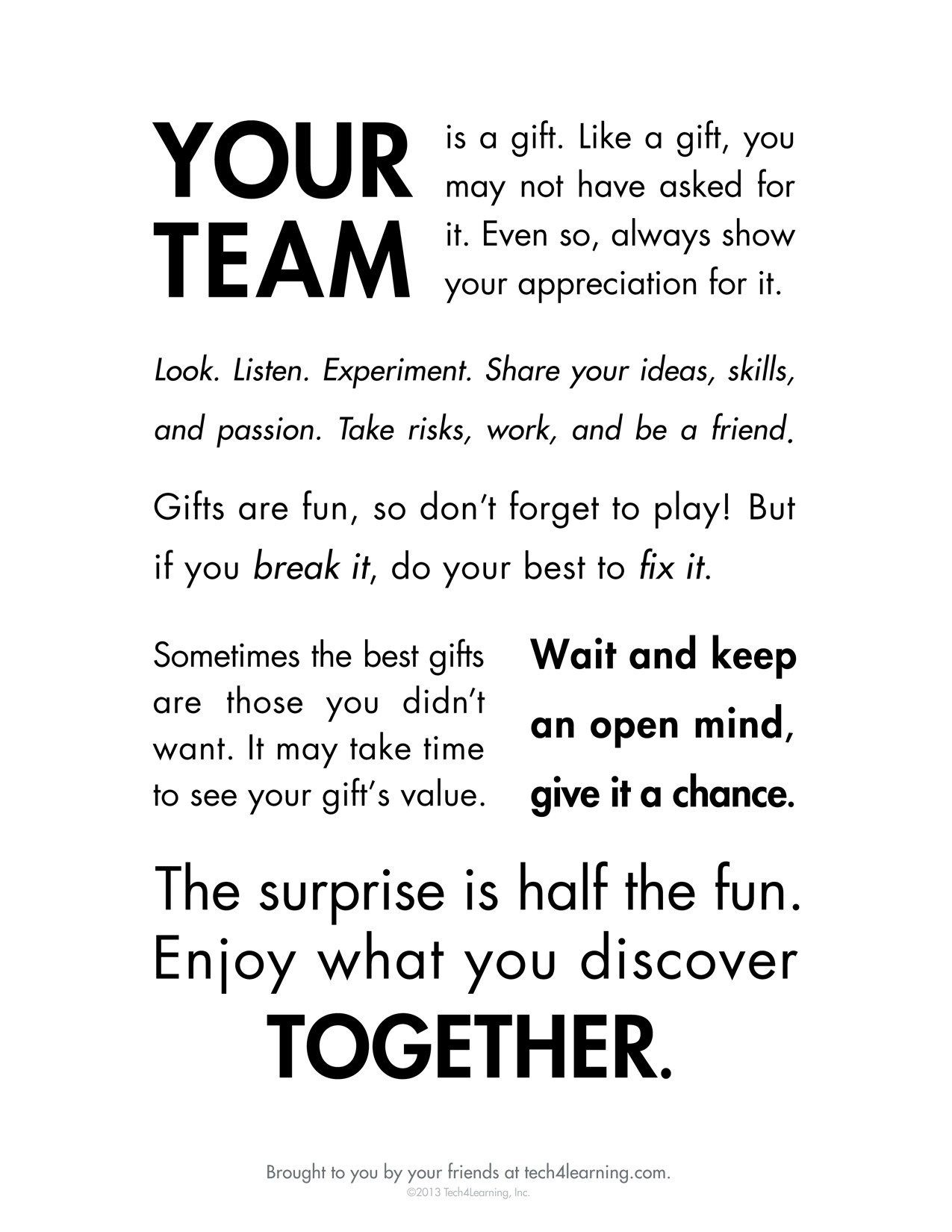
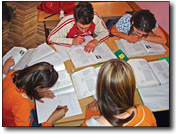
Collaborative learning entails more than just students working next to each other or even helping one another. As students work to formulate an answer to an open-ended task, they talk and work together. When students exchange ideas and insights, they work through misunderstandings, absorb content more effectively, and help each other achieve true understanding (Cohen & Lotan, 1997).
Collaboration or Cooperation?
The words collaborative and cooperative are often used interchangeably. During both collaborative and cooperative learning, students work together as they tackle new concepts and form new understandings. The two approaches are subtly different, but are both highly effective ways to organize classroom learning and project work.
In cooperative learning, students work together to achieve a goal or develop an end product which is usually content specific. Cooperative projects tend to be teacher-centered and teacher-directed.
In collaborative learning, students may still work toward a goal or develop an end product, but the process is characterized by self-responsibility and awareness, respect for others, and contributions from different perspectives. Collaborative projects tend to be student-centered and student-directed.
To be successful in a collaborative environment, students must learn to communicate freely and directly, support their team members, and value each member's contribution. Making collaborative groups heterogeneous helps students learn these important skills.
A heterogeneous group includes team members who:
- are different genders
- are different ethnicities
- prefer different subjects in school
- do not know each other very well
- have different “intelligences”
- have varying levels of academic proficiency
- have varying levels of technology proficiency
Grouping students by varying levels of expertise, ability, and skills helps foster positive interdependence and accountability. Various perspectives and experiences result in a richer pool of knowledge and provide benefits for both low and high achievers.
You will need to assess skills, competencies, and work styles before grouping students into successful teams. Try partnering opposites. For example, group a talkative student with a shy student, a techie with a non-techie, a risk-taker with a more cautious student. Make sure that each student sees the value of the contribution from the “opposite” and that each student moves outside of his or her comfort zone to experience the style of the other.
Rest assured, there is no perfect team and certainly no one way to group students. The key is to define your goals for the project and teach students to identify how they are interacting and then self-correct.
Roles in Group Projects
During collaborative work, you can foster positive interdependence by choosing roles for various team members. Roles help solidify the value of each member’s contribution and, in the case of large projects, help a team meet project requirements.

You can assign specific roles to each student or let the students assign roles within the group. Having team members rotate through the various roles requires them to tackle several different sets of skills and helps them see the value of each role.
 |
Leader When in this role, students facilitate group success by assessing progress toward the team goal and keeping the team on task and on track. Leaders are responsible for getting all team members to participate and for making sure that all team members understand the concepts and information necessary for the project. |
 |
Recorder When in this role, students collect and share the information discussed during team work, create a written record of work being done, write out solutions, keep copies of each member’s work, and prepare the materials for final project submission. |
 |
Encourager When in this role, students encourage other team members by listening carefully, sharing ideas, making connections, and expressing feelings. |
 |
Checker When in this role, students make sure that each team member understands what is being said, what work needs to be completed, and what the group has determined to be the project goals. |
 |
Timekeeper When in this role, students make sure that the team is on track to meet deadlines and complete the project on time. |
 |
Runner When in this role, students locate the person or thing which will help answer a question or find the resources team members need to complete project work. |
 |
Questioner When in this role, students should challenge the prevailing ideas, encouraging new ideas and helping the team work in new directions. |
You will want to further clarify these roles as they pertain to the specific project work your students are completing. You may also find that you want to divide or combine roles depending on the number of members in each team.
Work Styles
A team’s success is not solely dependent upon the academic capability of its members. It is also dramatically affected by how well the team can work together to achieve goals. Project success depends on team members successfully allocating tasks and assignments and communicating with each other as they progress through the process.
How team members interact is influenced by varying working styles. Understanding a student’s work style will help you facilitate communication between team members, encourage conflict resolution, and support successful project completion.
A work style is how a person chooses to approach a task. A student’s work style will vary over time, be largely dependent on the task or project at hand, and often reflects the work styles of other members on their team. There are four overarching work styles: driver, expressive, amiable, and analytical.
The driver prefers to take charge and lead the group. Expressive students share ideas and information freely. Amiable team members perform the work set out for the team. Analytical team members assess and evaluate work that has been done.
When you ask students to assume roles in their group, you want them to hone a particular set of work-style skills. For example, to be effective in the Leader role, students need to tailor their style to that of a Driver. To be effective in the role of Checker, students need to apply the Analytical work style.
Each work style contributes in a different way to team success. Drivers help teams achieve their goals. Expressives motivate team members. Amiables help everyone get along as they work. Analyticals ensure that the team gets the job done correctly. Optimally, during project work, team members will perform under all of the work styles.

Each style can also have a negative impact on a team’s performance. Drivers may dictate what the team is doing. Expressives may want to continue discussions without making decisions. Amiables may not speak up to have their good opinions heard. Analyticals may get bogged down in details and miss deadlines and team goals.
To achieve maximum results, a team needs to have someone working from each style at some point during the project-building process. Many times, these roles can be achieved by the same person. The true importance of knowing these work styles is to help all team members value one another’s contributions, as well as help the team overcome obstacles when work styles are conflicting.
Conclusion
Collaboration enhances student learning by modeling authentic work in the 21st century and helping students achieve the large-scale goals of a project in the time allotted.
Bibliography
Cohen, E. G. Designing Groupwork: Strategies for the Heterogeneous Classroom. New York: Teachers College Press.
Cohen, E. G., & Lotan, R. A. Working for Equity in Heterogeneous Classrooms: Sociological theory in practice. New York: Teachers College Press.
Johnson, D. W., & Johnson, R. T. Cooperative learning and achievement. In S. Sharan (Ed.) Cooperative Learning: Theory and Research (pp. 23-37). New York: Praeger.
Johnson, R. T., and Johnson D. W. “An Overview of Cooperative Learning.” Originally published in: J. Thousand, A. Villa and A. Nevin (Eds.), Creativity and Collaborative Learning; Baltimore: Brookes Press.
The Cooperative Learning Center at the University of Minnesota. https://www.co-operation.org



 Most Read